How to track calories without weighing every meal
A realistic guide to tracking calories without a food scale, using meal descriptions, portion estimates, progress trends, and AI food logging.
Logly
Food tracking guides
The biggest myth in calorie tracking is that you need a food scale to make it work. Food scales are useful, but they are not realistic for most people's lives. You eat at restaurants, at family gatherings, at your partner's house, at work. You cook meals from habit and feel rather than from precise recipes. You eat regional dishes that no database has ever heard of.
You do not need to weigh every gram to track your calories. What you need is a practical system that gives you enough accuracy to understand your eating patterns and make progress over time.
This guide covers how to track calories without a scale — what actually matters, what common mistakes to avoid, and how to use your weight trend as the ultimate feedback signal.
Why most people give up on calorie tracking
Most people who try calorie tracking quit within two weeks. The most common reasons are not confusion about calories — they are friction and perfectionism. Logging every meal takes too long. Missing one day feels like failure. Eating a homemade dish that is not in the database creates a dead end. Social eating becomes stressful. The app starts feeling like punishment.
A tracking system that requires a food scale at every meal adds another layer of friction that makes giving up more likely. The goal is not perfect tracking. The goal is consistent, close-enough tracking that produces useful feedback. Imperfect tracking you stick to for three months will always beat perfect tracking you quit after ten days.
Can you actually track calories without a scale?
Yes. You can track calories without weighing food by describing your meals clearly, estimating portions using familiar references, paying close attention to high-calorie ingredients, and using your weight trend as your feedback signal rather than trying to hit an exact daily number.
- Describe meals in normal language with ingredient context.
- Mention portion size — small, medium, large, or a rough size reference.
- Always include oils, sauces, bread, cheese, nuts, sweets, and drinks.
- Use your weight trend over two to four weeks as your accuracy check.
- Adjust estimates over time based on what the trend is telling you.
1. Better meal descriptions are more valuable than exact weights
The accuracy of an AI calorie estimate depends almost entirely on the quality of the description you provide. A detailed description of a meal without any weights will produce a much better estimate than a single food item with a precise gram count.
Think about what makes a meal high or low calorie. It is the main ingredients, the cooking fat, the sauces, the sides, the extras. Capture those details in your description and you have most of the information needed for a useful estimate.
| Weak log | Better log | Why it matters |
|---|---|---|
| breakfast | 2 scrambled eggs, 2 slices of bread, butter, coffee with milk | Adds fat source, portion, and drink |
| pasta | large bowl of pasta with cream sauce, chicken, and parmesan | Adds portion, protein, and high-calorie sauce |
| burger | beef burger with fries, mayo, and cola | Adds fat, sides, and sugary drink |
| salad | large salad with grilled chicken, feta, olives and olive oil dressing | Salads vary wildly — the extras matter most |
| dinner | homemade moussaka, medium portion, with bread | Names the dish, estimates the portion |
2. Focus on the ingredients that change calories the most
You do not need to obsess over every vegetable, spice, or condiment. The difference between logging and not logging cucumber slices is negligible. The difference between logging and not logging the cooking oil, the cream sauce, or the second serving of rice is significant.
High-calorie ingredients are the ones where inaccuracy matters most. These are the items that can make a meal twice as calorie-dense as it appears:
- Cooking oil and butter — 1 tablespoon of oil adds about 120 calories.
- Cheese — a generous handful of grated cheese can add 150–200 calories.
- Cream and cream sauces — half a cup of cream can add 200+ calories to a dish.
- Bread, rice, pasta, and potatoes — the base carb determines a large portion of total calories.
- Nuts and peanut butter — calorie-dense and easy to underestimate portion size.
- Sugary drinks and juices — liquid calories are the most commonly forgotten.
- Desserts, pastries, and snacks — often underlogged or entirely skipped.
3. Use portion language instead of pretending to be exact
If you did not weigh the meal, do not report a precise gram count that you invented. That false precision is actually worse than a honest estimate because it trains you to trust numbers that have no basis in reality.
Instead, use relative portion language that accurately reflects what you ate. Did you have a small plate or a large one? Was the chicken breast normal size or was it particularly large? Did you go back for seconds? Was the dish oilier than usual? These qualitative details give the AI useful context without requiring a scale.
Honest estimates beat false precision
"Large bowl of pasta, probably more than usual" is a more useful log than "250g pasta" when you have no idea whether it was actually 250g. Honest estimates build a more accurate picture over time.
Common portion references that help without a scale: a palm-sized piece of protein is roughly 100–150g, a fist-sized portion of cooked rice or pasta is roughly 150–200g, a thumb-sized amount of butter or peanut butter is roughly 15–20g, a cupped hand of nuts is roughly 30g.
4. Use your weight trend as your feedback signal
This is the most underrated strategy in calorie tracking without a scale. Your estimates do not need to be perfectly accurate on any given day. They need to be consistent enough that your weight trend over two to four weeks reflects the direction you are trying to go.
If you are trying to lose weight and your calorie estimates suggest you are in a deficit, but your weight trend is flat or rising, one of two things is happening: either you are significantly underestimating portions or missing calories, or there is another factor like water retention or a very slow metabolism. Either way, the trend is giving you accurate feedback that your estimates need adjusting.
Conversely, if your estimates look accurate and your weight trend is moving in the right direction, you know your system is working even without a scale. The feedback loop is real even if the individual data points are estimates.
5. When you should still weigh food
You do not need to weigh every meal forever, but there are situations where it makes sense. Weighing specific high-calorie foods for a short period teaches you what portions actually look like, which improves your estimates long after you stop weighing.
If you have never weighed a tablespoon of peanut butter, you probably think your usual serving is about a tablespoon. Most people's "one tablespoon" of peanut butter is actually two to three tablespoons. A few days of weighing that one food can permanently calibrate your mental model.
- Rice, pasta, oats, and cereal — carb portions are easy to overestimate visually.
- Peanut butter and nut butters — one of the most underestimated foods.
- Nuts and seeds — calorie density is high and handful sizes vary enormously.
- Cooking oil — most people use significantly more than they think.
- Cheese — grated cheese especially tends to be used in larger quantities than estimated.
- Protein powder — scoops vary between brands and personal habits.
Spend one week weighing these specific foods while otherwise tracking normally. You will learn more about your real calorie intake from this exercise than from months of unweighed tracking.
6. Common mistakes that cause tracking to fail without a scale
The most common reason scale-free tracking produces poor results is not the method itself — it is specific, predictable mistakes that are easy to fix once you know what to look for.
- Forgetting drinks: coffee with milk and sugar, juices, soft drinks, alcohol, and smoothies all have calories that add up quickly.
- Ignoring cooking fat: if you fried or sautéed something in oil, that oil needs to be included.
- Underlogging sauces: a generous serving of tzatziki, cream sauce, or salad dressing can add 100–200 calories.
- Not logging snacks: handfuls of nuts, a few biscuits, a spoonful of peanut butter — these are small moments that add up.
- Describing portions as 'normal' when they are actually large: be honest with yourself about whether your portion is genuinely average.
- Only logging on good days: accurate tracking requires logging on high-intake days too, not just days when you ate well.
How Logly makes scale-free tracking easier
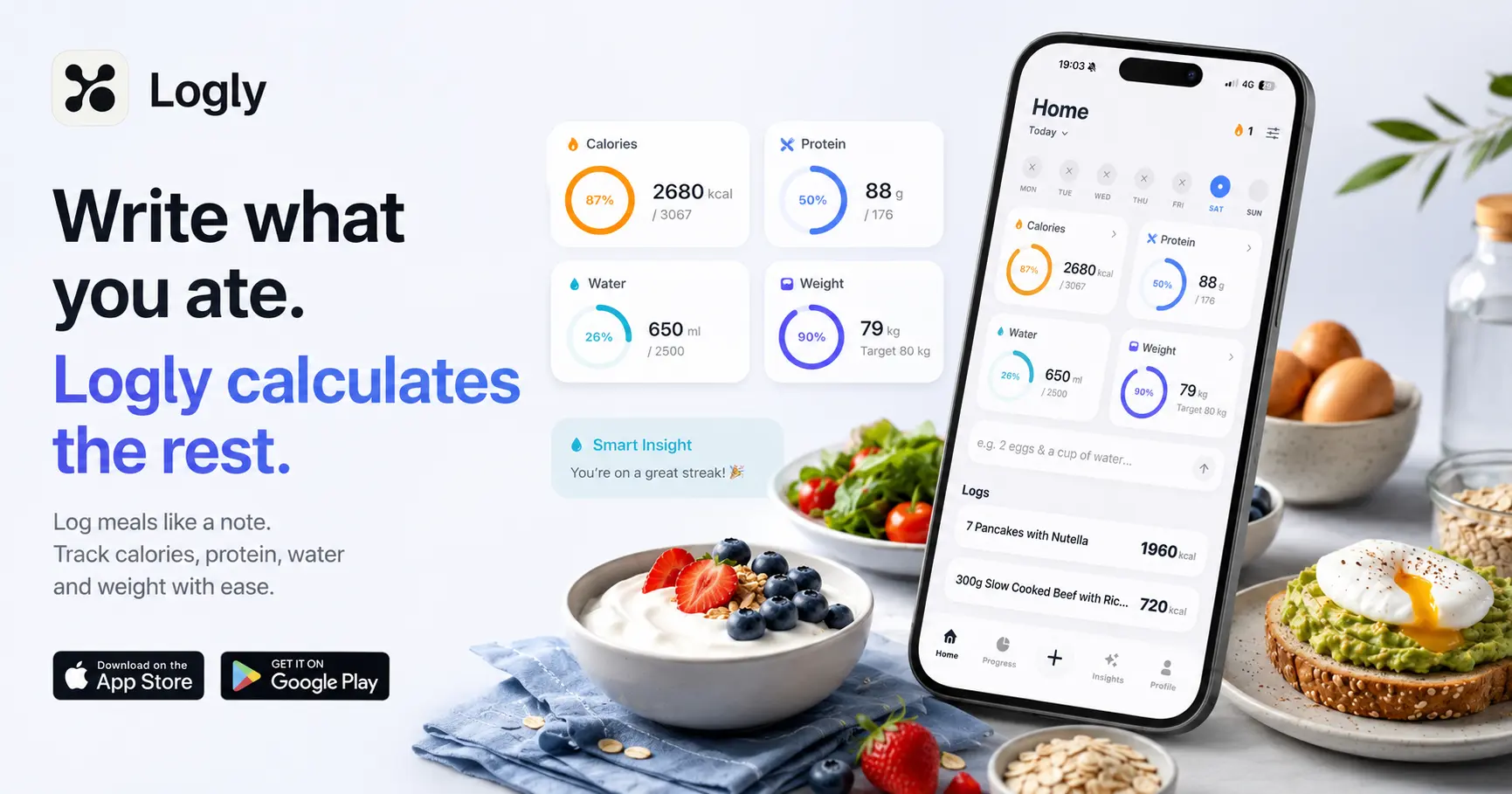
Logly is built specifically for the way most people eat. You write what you ate like a normal note — no searching, no barcodes, no database hunting. Logly estimates the calories, macros, and protein from your description, lets you adjust the estimate if needed, and tracks your progress over time through weight, photos, and measurements.
Because Logly is designed for natural language logging, it handles the kinds of meals that defeat traditional databases: homemade dishes, mixed plates, regional foods, family meals, and restaurant estimates.
FAQ
Is tracking without weighing less accurate?
It can be less precise, yes. But for most people it is significantly more sustainable. A consistent estimate over 12 weeks will produce more useful data than perfect tracking for 10 days followed by nothing. The accuracy that comes from consistency matters more than the accuracy that comes from precision.
Can I lose weight without weighing food?
Yes. Weight loss depends on your overall calorie balance over time. If your estimates are reasonably accurate and your weight trend is moving downward, your system is working. Use the trend as your guide and adjust estimates when the trend tells you something is off.
Should beginners weigh food?
Beginners benefit most from weighing a small number of high-calorie foods for a short period to calibrate their portion intuition. They do not need to weigh everything forever. Learning what 30g of nuts looks like and what 200g of cooked pasta looks like is usually enough to improve estimate quality significantly.
How many calories do I need per day?
Daily calorie needs depend on your height, weight, age, activity level, and goal. A rough starting point for most moderately active adults is around 2,000–2,500 calories for maintenance. For weight loss, a moderate deficit of 300–500 calories below maintenance is a common starting point. Track for two weeks and adjust based on your weight trend.
Track meals faster
Food tracking should feel simple.
Logly helps you log meals with AI, track calories and macros, follow your weight trend, add progress photos, and stay consistent without making nutrition feel like homework.
Related guides