AI food tracker vs calorie counter: what is the difference?
AI food trackers and traditional calorie counters both help with nutrition, but they feel very different to use. Here is how to choose the right one for your lifestyle.
Logly
Food tracking guides
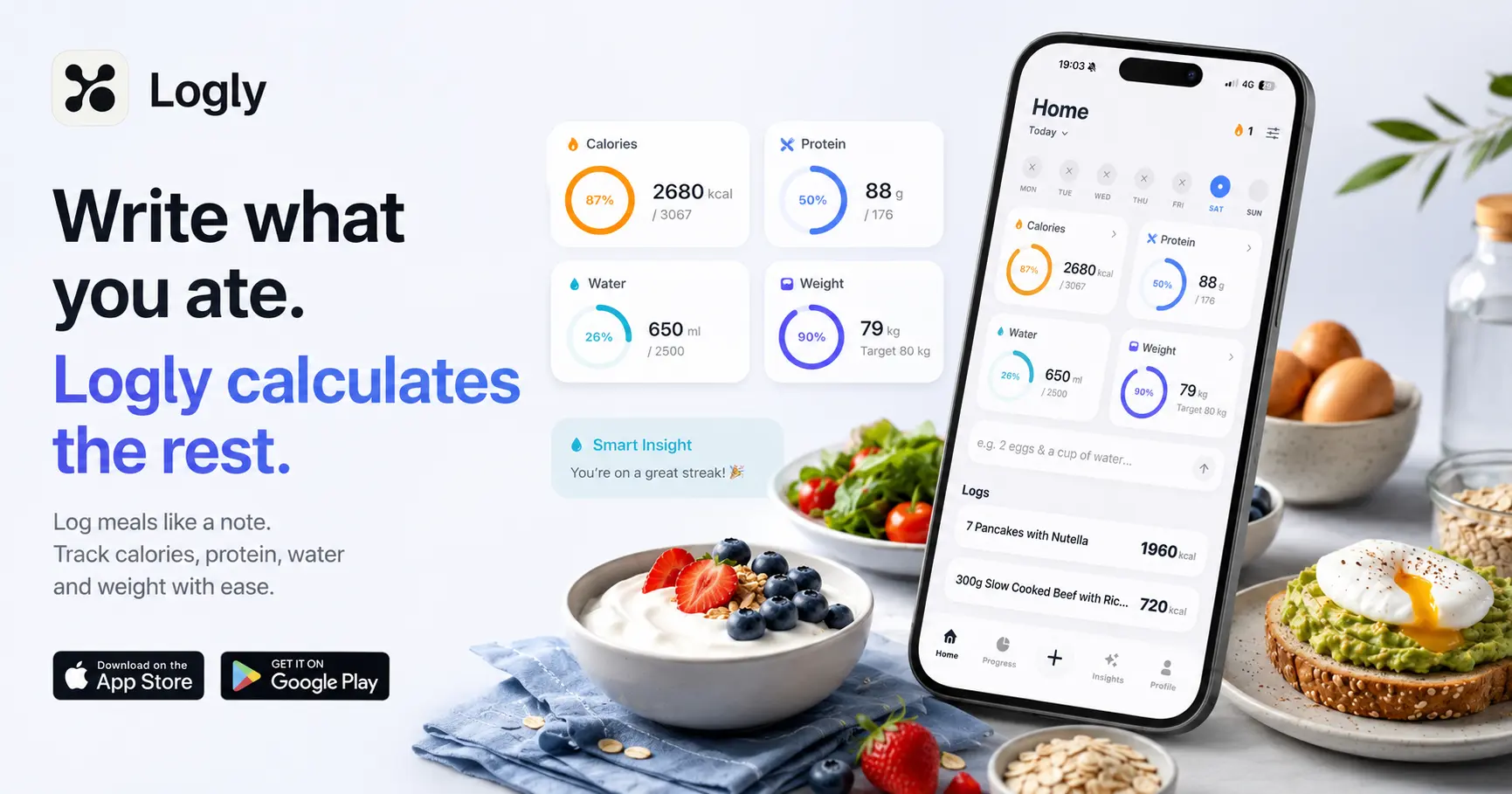
Both AI food trackers and traditional calorie counters exist to help you understand what you are eating. The difference is not about the goal — it is about how the food gets logged, how much friction is involved, and which type of eating each method handles well.
Choosing the wrong tool for your lifestyle is one of the most common reasons people give up on food tracking. If you eat mostly packaged foods with clear nutrition labels, a database-based calorie counter can work well. If you cook at home, eat cultural or regional food, or simply do not want to spend minutes searching for each ingredient, an AI food tracker will feel like a completely different experience.
How traditional calorie counters work
Traditional calorie counters are built around a food database — usually a very large one with millions of entries. To log a meal, you search for each food item, choose the closest match, set the serving size or gram weight, and add it to your log. Repeat for every component of every meal.
This approach has real advantages when the food is well-represented in the database. Packaged foods with nutrition labels are the best case: you scan the barcode, the app pulls the exact nutrition data from the label, and you set the serving size. The result is as accurate as the label itself.
The limitations become apparent outside that use case. Homemade food is not in the database. Mixed dishes require logging every ingredient separately and then accounting for portions within the total. Regional foods, family recipes, and restaurant meals are represented poorly or not at all. And for every meal, you are doing multiple searches, comparisons, and corrections.
Traditional calorie counters are best for exact packaged foods
- Packaged snacks, bars, and cereals with nutrition labels.
- Branded products where barcode scanning works reliably.
- Restaurant chains that publish verified nutrition data.
- Pre-portioned foods where exact gram weights are available.
- Athletes and bodybuilders who weigh every ingredient and want precise database entries.
How AI food trackers work
An AI food tracker replaces the database search with natural language processing. Instead of searching for "chicken breast, grilled, 150g" and then separately adding "white rice, cooked, 200g," you write or say: "grilled chicken with rice and a side salad, medium portion." The AI interprets the description and produces an estimated calorie and macro breakdown.
The underlying AI has been trained on large amounts of nutrition data and can estimate the likely calorie content of most described meals, including culturally specific dishes, approximate portions, and mixed plates. It is not perfectly accurate — no AI is — but it is usually accurate enough to be useful, and it is dramatically faster than database searching.
AI food trackers are better for normal meals
- Homemade dishes where no database entry exists.
- Family-style meals where portions are unclear.
- Cultural and regional foods like burek, sarma, shakshuka, or dal.
- Restaurant meals from independent restaurants without nutrition data.
- Mixed bowls and plates with multiple components.
- Quick logging when you want to describe a meal in seconds.
- Any situation where searching a database feels too slow or frustrating.
The accuracy comparison
Database tracking is more accurate when the food is in the database and the entry is correct. Both of those conditions are more fragile than they appear. Many database entries are user-submitted and incorrect. Portion sizes in databases rarely match how the food was actually cooked. And if the food is not in the database at all, the accuracy is zero — you either skip it or guess.
AI tracking produces estimates rather than exact figures. For most meals, the estimates are within a reasonable margin. For simple, well-described meals, AI estimates are often closer to reality than database entries for similar foods, because the AI is working from your actual description rather than a generic database entry.
The accuracy question is more nuanced than it seems
A database entry for "chicken breast" that you found by searching is not more accurate than an AI estimate if it does not match how your specific chicken was cooked, seasoned, and portioned. Accuracy depends on context, not just the method.
Speed comparison
This is where AI tracking has an obvious advantage. Logging a complex homemade meal with five ingredients in a traditional calorie counter might take three to five minutes of searching, adjusting serving sizes, dealing with duplicate or incorrect database entries, and then assembling the total. With AI tracking, the same meal takes ten to twenty seconds to describe.
That time difference compounds. If logging feels fast, you log more consistently. If it feels slow and tedious, you skip meals, round numbers, or quit entirely. Consistency over weeks and months matters more for outcomes than the precision of any individual log entry.
The best system may use both
For many users, the most practical approach is to use AI tracking as the default and fall back to database search or barcode scanning for packaged foods where exact nutrition data is available. This gives you the speed of AI for most meals and the precision of database entries when it matters most.
Where AI trackers can be wrong
AI tracking has specific failure modes that are worth knowing. Portion size is the most common source of error — the AI cannot know how large your serving was unless you tell it, and vague descriptions lead to average estimates that may not reflect your actual intake. Cooking fat is another common miss: a dish described as "pasta with chicken" might be estimated as a low-oil preparation when it was actually cooked in significant amounts of oil.
Hidden ingredients are a third issue. If a sauce contains cream, sugar, or flour that you did not mention, those calories will not appear in the estimate. The solution is to describe the dish in enough detail that the AI can account for the most calorie-dense parts — and to adjust the estimate when you know it is off.
Which one should you choose?
- Choose a traditional calorie counter if: you eat mostly packaged foods, you weigh your food, you want exact database entries, or you are an athlete tracking precise macros.
- Choose an AI food tracker if: you eat homemade meals or mixed dishes, you want fast logging, you eat cultural or regional food, or the database search experience has made you quit tracking before.
- Use both if: you want the speed of AI for most meals with the precision of barcode scanning for packaged foods.
- Choose a progress-focused tracker like Logly if: you also want to track weight, water, photos, and measurements in the same app alongside your food.
FAQ
Which is more accurate — AI tracker or calorie counter?
It depends on the food. Database tracking is more accurate for exact packaged foods with verified nutrition data. AI tracking is often more accurate for homemade meals, mixed dishes, and restaurant food, because it works from your description of the actual meal rather than a generic database entry.
Can AI food trackers handle cultural foods?
Good AI food trackers handle a wide range of cultural dishes reasonably well because they are trained on diverse food knowledge rather than relying on a structured database. Results vary by dish, but for common regional foods like burek, moussaka, rice dishes, or stews, AI estimates are usually usable.
Is there a free AI calorie tracker?
Several apps offer free tiers with AI food logging features. Features, accuracy, and daily log limits vary between apps. Most free tiers are useful enough to evaluate whether AI tracking works for your lifestyle before committing to a paid plan.
Track meals faster
Food tracking should feel simple.
Logly helps you log meals with AI, track calories and macros, follow your weight trend, add progress photos, and stay consistent without making nutrition feel like homework.
Related guides