Best AI calorie tracker: what to look for in 2026
A practical guide to choosing an AI calorie tracker that helps you log food faster, track macros, and understand your progress without making nutrition feel complicated.
Logly
Food tracking guides
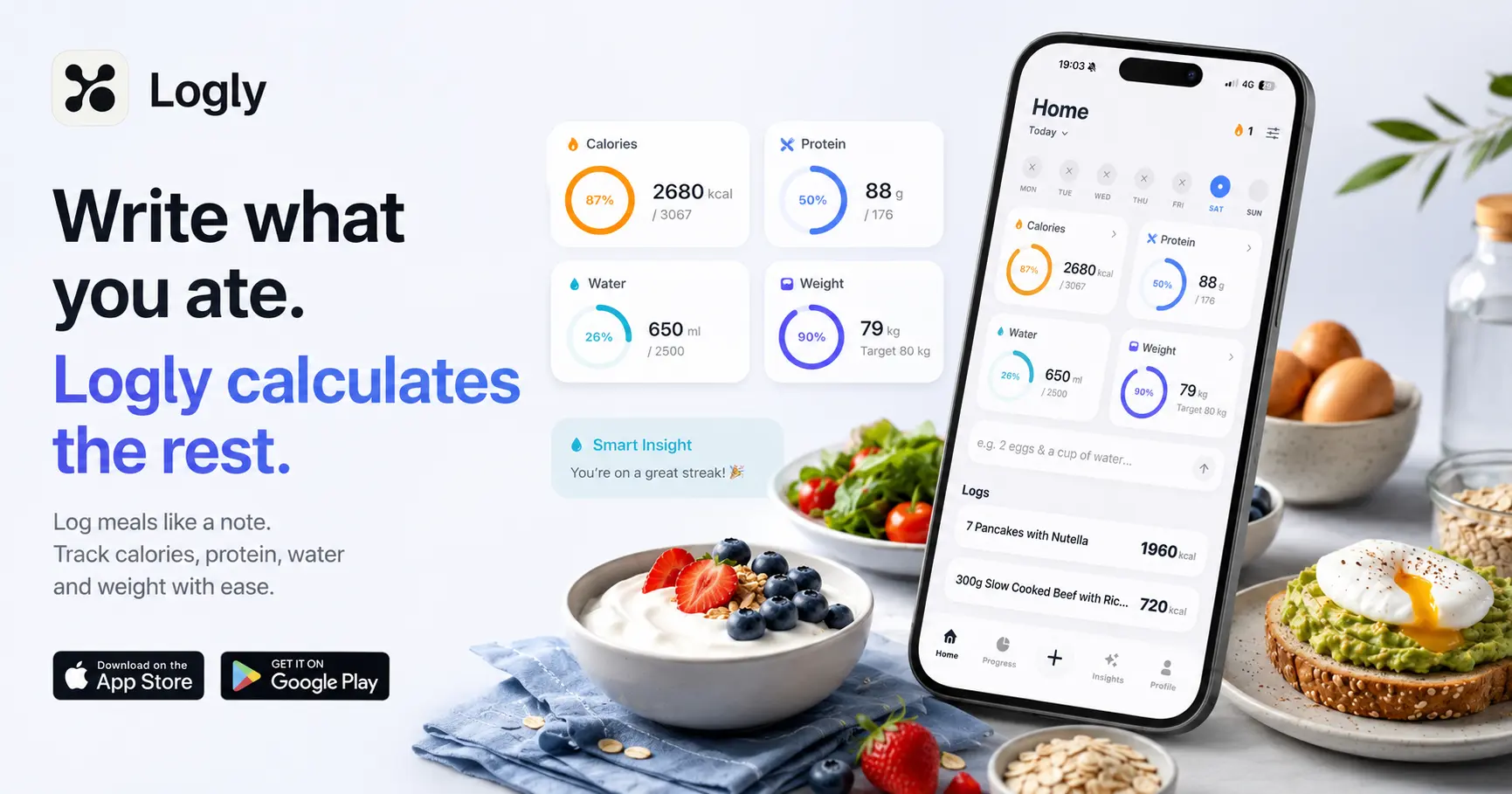
AI calorie trackers have changed how people approach food logging. Instead of searching a database for every single ingredient, you describe what you ate in normal language and the app estimates your calories and macros instantly. That shift sounds small, but it removes the biggest reason people quit tracking: it takes too long.
But not every app that calls itself an AI calorie tracker is actually useful. Some add AI as a marketing feature while the core experience is still a clunky food database with a chatbot bolted on. Others generate estimates with no way to correct them when they are wrong. And some are so focused on features that the basic act of logging a meal takes more steps than it should.
This guide covers exactly what makes an AI calorie tracker worth using in 2026, what to avoid, and how to pick one that fits the way you actually eat.
What makes a good AI calorie tracker?
Before comparing apps, it helps to understand what the core job is. A calorie tracker exists to help you understand your nutrition without making the process so annoying that you stop. Everything else — AI, macros, progress charts — is in service of that goal.
- It lets you log meals in normal language, not only by searching a database.
- It gives calories and macros, not just a single calorie number.
- It lets you edit the estimate when the portion or ingredients are wrong.
- It connects food logging with weight, water, photos, measurements, and progress.
- It helps you stay consistent instead of making tracking feel like homework.
- It works for the food you actually eat, including homemade meals and cultural dishes.
- It surfaces useful insights without overwhelming you with data.
1. Natural meal logging should be the core feature
The main reason people want an AI calorie tracker is speed. If logging a meal still takes two minutes of searching, scrolling, correcting, and picking database entries, the AI part does not matter much.
A strong AI food tracker should understand meals written like normal notes. "2 eggs with bread and yogurt." "Chicken rice bowl with salad." "Burek with yogurt and a coffee." "Homemade pasta with chicken, cheese and a bit of cream." These are the kinds of descriptions that reflect how people actually eat and talk about food.
The AI should handle mixed meals, approximate portions, regional foods, and vague descriptions without falling back to a blank search bar. If the app only works well for common packaged foods but struggles with a plate of homemade moussaka or a family-style meal, it is not genuinely useful for most people.
Good food logging should feel natural
The user should not have to think like a database. They should be able to describe the meal the way they would say it to a person, and the app should handle the nutrition estimate from there.
Photo logging is another useful input method. You take a picture of your meal and the AI tries to estimate what is in it. This works reasonably well for simple, clearly visible meals, but it tends to struggle with portion depth, hidden ingredients, and sauces. Text descriptions with some context usually produce more accurate estimates.
2. Calories alone are not enough
Total calories are important, but they do not tell the full story of your nutrition. Two meals can have identical calorie counts but feel completely different, support different goals differently, and affect your energy and fullness in opposite ways.
A 600-calorie meal that is mostly protein and vegetables will keep you full for hours and support muscle maintenance. A 600-calorie meal that is mostly refined carbs and fat may leave you hungry an hour later. Calories are the starting point, not the whole picture.
- Calories: total energy intake, the foundation of weight management.
- Protein: supports fullness, muscle recovery, and maintenance during weight loss.
- Carbohydrates: your main energy source, especially relevant for training.
- Fat: important for hormones, satiety, and calorie-dense meals.
- Fiber: affects digestion, fullness, and how quickly energy is absorbed.
- Water: hydration habits affect energy, recovery, and how the scale fluctuates.
- Weight trends: the long-term signal that shows whether your nutrition plan is working.
This is why macro tracking matters. Knowing your protein for the day, for example, can explain why you are constantly hungry despite hitting your calorie target. It can also help you understand why two weeks of consistent eating has not produced the results you expected.
3. The estimate must be editable
AI nutrition estimates are useful, but they are not magic. No AI can perfectly determine how much oil was used, whether you ate the whole portion or left some, how thick the cream sauce was, or whether you grabbed a second slice of bread. These details matter.
The best AI calorie trackers make it easy to adjust the estimate. If the app guesses 480 calories but the meal was clearly larger than described, or if you added more oil than usual, you should be able to increase the calories, adjust the macros, or flag the portion as larger without fighting the interface.
Apps that lock the AI estimate in place and make editing awkward are actively working against the user. Editability is not a nice-to-have — it is a core part of building accurate tracking habits over time.
Accuracy improves when you can correct the AI
An estimate you can edit and refine over time becomes more accurate than a locked estimate that was slightly wrong from the start. The goal is a system you can trust, not a system that pretends to be perfect.
4. Progress tracking makes food logging more useful
Food logs are only one side of the story. Progress shows what is actually happening in your body over time. A calorie tracker that only tracks food is missing half the information you need to understand whether your approach is working.
The most useful trackers connect food logging with weight trends, body measurements, progress photos, and weekly summaries. When you can see your average calories for the week alongside your weight trend for that same week, patterns become much clearer than they ever would from daily numbers alone.
Progress photos are particularly valuable because the scale does not show body composition changes. Someone losing fat while building muscle may see very little change on the scale over several weeks, but a progress photo comparison will clearly show the difference. Having this context inside the same app as your food log makes it easier to connect the dots.
- Weight tracking: log daily or a few times per week to see the weekly trend, not just daily fluctuations.
- Progress photos: front, side, and back photos every two to four weeks to show body composition changes.
- Body measurements: waist, hips, arms, and chest to track size changes independent of scale weight.
- Weekly summaries: average calories, average protein, consistency rate, and whether the trend is moving in the right direction.
5. The app should help you stay consistent
Most people do not fail to reach their nutrition goals because they do not know what calories are. They fail because the process becomes annoying, time-consuming, or demotivating. Tracking every meal manually gets tedious. Seeing a long streak broken by one missed day feels discouraging. Entering the same breakfast six days a week feels pointless.
A good tracker should reduce friction at every step. Logging should be fast. Targets should be visible without hunting. Weekly insights should be actionable, not just data dumps. Reminders should be optional, not intrusive.
Consistency over weeks and months matters far more than perfect accuracy on any single day. The best AI calorie tracker is not the one with the most sophisticated AI — it is the one you can keep using without it feeling like a second job.
The real goal
The best calorie tracker is not the one with the most features. It is the one you can keep using consistently. A simple app you log in every day will produce better results than a sophisticated app you abandon after two weeks.
6. It should work for the food you actually eat
Generic food databases are built around American and Western European packaged foods. They tend to handle a chicken sandwich or a cup of oatmeal well. They struggle with burek, sarma, tavče gravče, pljeskavica, shakshuka, dal, injera, or any of the thousands of regional dishes that millions of people eat every day.
If an AI food tracker cannot handle the food you actually cook and eat, it will not work for your life. This is one of the biggest practical advantages of natural language AI logging over database search: a good AI model understands food descriptions from many cuisines and cultures, even when a specific dish is not in any formal database.
7. Weekly insights turn data into decisions
Daily tracking is useful for staying aware of what you are eating. But the real value comes from weekly patterns. Did you hit your protein target most days? Were your calories consistently below or above target? Did your weight trend up or down? Was your water intake lower on the days you felt tired?
A good AI calorie tracker should surface these patterns automatically, so you do not have to build your own spreadsheet to see them. Weekly insights should tell you something actionable — not just "you logged 5 out of 7 days" but "your protein was low on most days, which may explain the hunger you mentioned."
How Logly approaches AI calorie tracking
Logly is built around the idea that food logging should be as simple as writing a note. You describe what you ate in your own words — whether that is "eggs and bread" or "large plate of homemade chicken rice with yogurt sauce" — and Logly estimates the calories, protein, carbs, fat, and other key nutrition details.
Instead of being only a calorie counter, Logly connects food logging with weight tracking, water intake, progress photos, body measurements, and weekly insights in one place. The goal is to give you a complete picture of your nutrition and progress without making you manage multiple apps.
Logly is designed for iPhone and is particularly well-suited for people who eat homemade meals, mixed dishes, or regional foods that are difficult to find in standard databases.
FAQ
Are AI calorie trackers accurate?
AI calorie trackers can produce useful estimates for most meals, but they are not perfectly accurate. Accuracy depends on how well you describe the meal, whether you include portion details, and whether you correct the estimate when you know it is off. For most people, consistent estimates that are slightly imperfect will still produce better results than not tracking at all.
Is an AI calorie tracker better than a traditional food database?
For most people who eat homemade meals or mixed dishes, yes. AI is faster and more flexible. A database can still be useful for packaged foods with exact nutrition labels, since those figures are verified. A good approach is to use AI for most meals and rely on database or barcode scanning only when you have an exact packaged food.
Can I use an AI calorie tracker for weight loss?
Yes. Tracking calories and macros consistently is one of the most reliable ways to understand your eating patterns and make adjustments that support weight loss. Combining food logs with weight tracking, protein targets, and progress photos gives you a complete view of whether your approach is working.
What macros should I track for weight loss?
Calories are the most important number for weight loss. After that, protein is the most useful macro to track because it helps with fullness and muscle maintenance during a calorie deficit. Tracking carbs and fat is helpful for understanding meal structure but is less critical at the beginning.
Do I need to weigh food to use an AI calorie tracker?
No. AI calorie trackers are specifically designed to work without a food scale. You describe the meal and include rough portion context — small, normal, large — and the AI handles the estimate. The results will be less precise than weighed measurements, but they are usually accurate enough to identify patterns and make progress.
Track meals faster
Food tracking should feel simple.
Logly helps you log meals with AI, track calories and macros, follow your weight trend, add progress photos, and stay consistent without making nutrition feel like homework.
Related guides