Water tracker app: how to build a real hydration habit
Water tracking can meaningfully improve your consistency and energy. Learn how to set a realistic goal and actually stick to it.
Logly
Food tracking guides
Most people who decide to drink more water fail within a week. Not because they are undisciplined, but because the habit requires attention at a frequency — six to eight times a day — that is hard to maintain on willpower alone. A water tracker adds the structure that willpower cannot sustain.
The goal of a water tracking app is not to make you obsessive about hydration. It is to make adequate water intake the default rather than the exception — to shift drinking water from something you intend to do to something that happens as part of your daily routine.
Why hydration matters for nutrition and health
Water is involved in virtually every physiological process: nutrient transport, temperature regulation, joint lubrication, digestion, hormone function, and cognitive performance. The effects of even mild dehydration — 1 to 2% below optimal — on cognitive function, mood, and physical performance are measurable in research settings.
For people tracking nutrition and fitness, hydration is particularly relevant because dehydration affects the scale reading. Water retention changes account for most of the day-to-day fluctuations in body weight. Understanding whether a scale reading reflects a change in fat or a change in hydration status requires consistent water intake as context.
- Supports digestion and nutrient absorption from food.
- Reduces false hunger signals — thirst is sometimes misread as hunger.
- Affects scale weight through water retention changes.
- Supports exercise performance and recovery.
- Helps with skin health and general energy levels.
- Pairs with fiber intake to support digestive regularity.
How much water do you actually need?
The widely cited "eight glasses per day" is a rough approximation that does not account for body size, activity level, climate, or dietary water content. A more useful framework is to target roughly 35 millilitres per kilogram of body weight per day under normal conditions. For a 70kg person, this is approximately 2.5 litres per day from all sources.
Activity, heat, and sweat significantly increase water needs. On training days or in hot weather, adding 500 millilitres to one litre above your baseline is a reasonable starting adjustment. Urine colour is a practical real-time indicator: pale yellow means well-hydrated, dark yellow means you need more water, and colourless is usually unnecessary overhydration.
Set a realistic target and build from there
Setting a water goal that is far above your current intake and expecting to hit it immediately is a reliable way to feel like you failed and give up. A better approach is to set a target that is achievable with modest effort — perhaps 300 to 500 millilitres above your current typical intake — and increase it gradually over two to three weeks.
Once you are consistently hitting a lower target, it becomes a baseline to build from. Gradual increases in water intake are more sustainable than dramatic jumps, and they allow your body to adjust to higher hydration levels rather than the discomfort of forcing large amounts of water all at once.
Strategies that actually work for drinking more water
- Drink a full glass of water immediately after waking up — before coffee, before checking your phone.
- Attach water to existing habits: a glass before every meal, a glass after every bathroom visit.
- Use a large water bottle that makes visual progress clear — seeing the level drop is more motivating than logging small glasses.
- Set two or three mid-day reminders rather than relying on thirst.
- Make water easily accessible — a bottle on your desk is consumed; a glass you have to refill in the kitchen is not.
- Count tea and coffee in your total, but do not use them as replacements for plain water.
Make logging water as fast as possible
The easier it is to log water, the more likely you are to do it. If logging a glass of water takes more than two seconds, you will not do it consistently eight times a day. Look for a water tracker that offers quick-add buttons — tap once to add a set amount — rather than requiring you to enter a number and confirm each time.
Widget support on iPhone is particularly useful for water tracking. A home screen widget that shows your current water intake and lets you log directly without opening the app reduces the friction to almost nothing.
How water intake connects to nutrition tracking
Water intake does not exist in isolation from the rest of your nutrition. Understanding the relationship between hydration and weight fluctuations is one reason to track both in the same app. If your weight went up 1.5kg overnight but you also had a high-sodium meal and drank unusually little water, the water retention explanation is obvious. Without both data points available, that weight change looks alarming rather than explainable.
Similarly, the appetite suppression benefit of water is most useful when you can see whether low water days coincide with high-calorie days. These patterns become visible only when water and food are tracked together.
How Logly tracks water
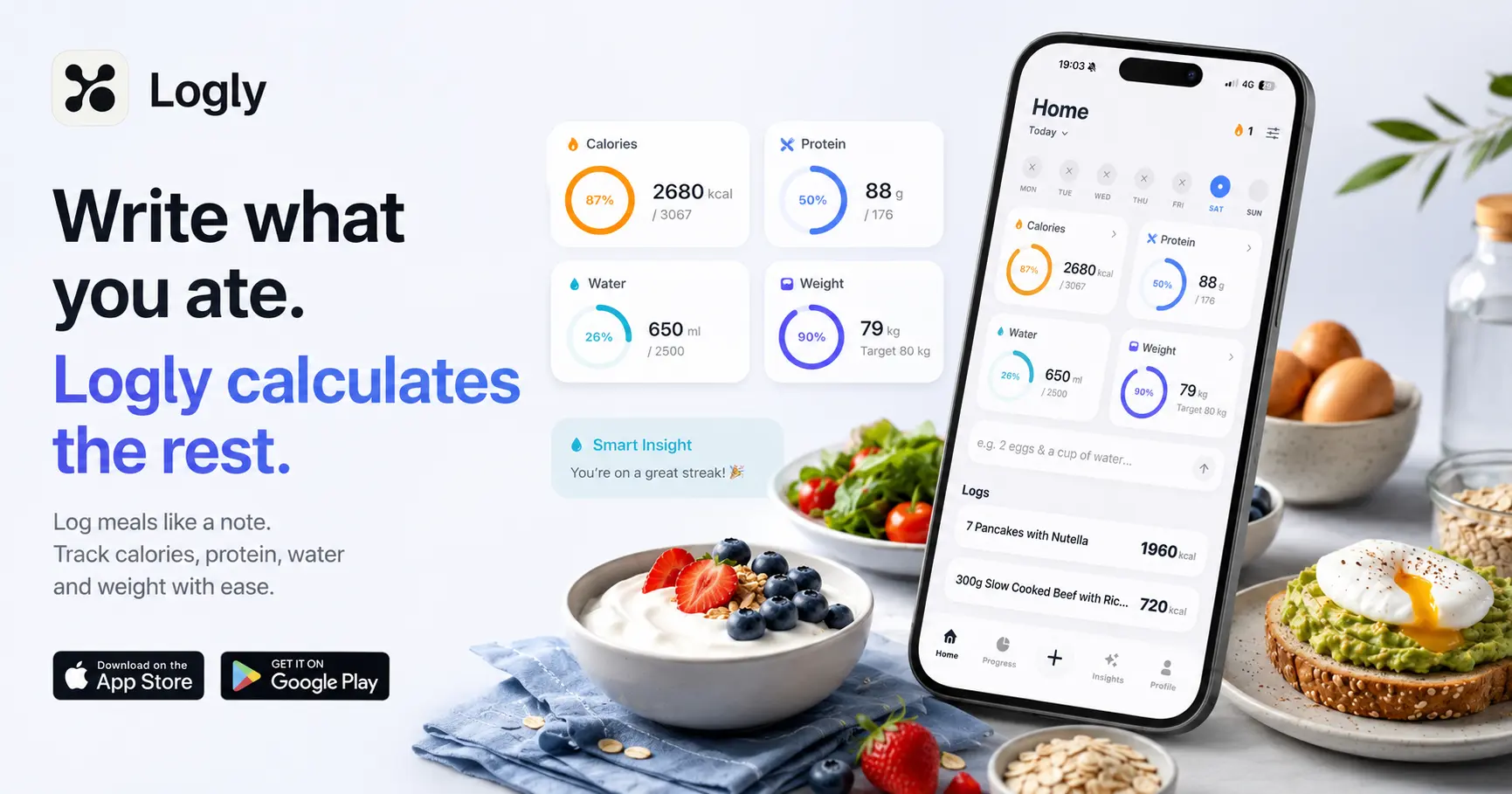
Logly lets you track water intake alongside calories, macros, protein, weight, and progress. Quick-add logging keeps the habit friction low, and seeing your water intake in context with your nutrition data makes it easy to spot the days where hydration was low and understand how it might have affected your hunger, energy, or scale reading.
FAQ
Does coffee count toward daily water intake?
Yes, despite the common claim that coffee is dehydrating. The mild diuretic effect of caffeine is offset by the fluid in the coffee itself, and research confirms that moderate coffee consumption contributes to daily fluid intake. Tea and other non-alcoholic beverages also count. Alcohol, however, is net dehydrating.
Can drinking more water help with weight loss?
Drinking water before meals has been shown to modestly reduce meal size and calorie intake. The mechanism is simple — water fills stomach volume, which activates fullness signals. A glass of water 15 to 30 minutes before a meal is a low-effort strategy for modest calorie reduction. Over time, this adds up.
Track meals faster
Food tracking should feel simple.
Logly helps you log meals with AI, track calories and macros, follow your weight trend, add progress photos, and stay consistent without making nutrition feel like homework.
Related guides